
There's a specific kind of tired that doesn't show up on a blood test. Not the tired from a bad night. The tired that sits underneath a person for months, the kind where you catch yourself standing in the kitchen with the fridge open, unsure what you walked in for, and it's not the third time that's happened this week, it's the third time today.
I want to start there instead of with a product, because the product isn't the interesting part. The interesting part is a pattern I didn't notice until I actually laid it out, and once I saw it, a lot of things that had felt random for two years suddenly didn't.
The Part Nobody Warns You About
Everyone tells you about the hot flashes. Fair enough, they're the visible symptom, the one people joke about, the one that has a name attached to it that everyone already knows.
Nobody really prepares you for the rest of it. The 3am wide-awake-for-no-reason nights. The way a sentence can just leave your head mid-conversation. The flatness that isn't sadness exactly, just a dimmer switch turned down on things that used to feel automatic.
I brought it up to my doctor at a regular appointment. She was kind about it, not dismissive in an unkind way, just brief. "That's perimenopause," she said, and we moved to the next item on the list. Fifteen minutes total. I left with a pamphlet about calcium and a vague sense that I'd been handed a label, not an answer.
"Just aging" sounds like an explanation. It functions like a door closing.
If the cause is simply aging, there's nothing specific to investigate, which means nothing specific is expected to fix it either. So you stop looking for something specific, and you start looking for something general instead.
I don't think that means she didn't know about ingredient-level research like this. Fifteen minutes doesn't leave room to walk through a specific compound's trial data, that's not a knock on her, it's just what a general appointment actually has time for. Finding this wasn't going to happen in that room. It was always going to happen on my own time, which is exactly where I found it.
What I Actually Tried
I did the responsible thing, which in this case meant researching it myself since the fifteen-minute appointment hadn't given me much to work with.
Magnesium came up everywhere. So I tried it. And here's what's strange, it actually helped, for about four days. Falling asleep came easier. I remember feeling almost embarrassed by how relieved I was over something that small.
Then it stopped. Not gradually. It just stopped mattering, the way something does when it was never really touching the actual problem to begin with.
I tried melatonin next. That one knocked me out, but I woke up more foggy than the sleeplessness had left me in the first place, which felt like trading one problem for a worse-timed version of it. I tried one of those all-in-one "menopause support" blends with a label listing eleven different ingredients. I couldn't tell you if any single one of them was doing anything, and I suspect that's because none of them were dosed high enough to do much of anything on their own.
At no point in this did I stop trying. I wasn't inconsistent. I wasn't careless. I did the research, I followed through, I gave each thing a real chance. And I was still tired in the same specific, familiar way, two years in.
That's the part that eventually stopped making sense to me. If this was really just aging, a fixed and general decline, why did something actually work, briefly, before stopping? A truly unfixable thing doesn't respond and then hit a wall. Something that specific was happening. I just didn't have the explanation for it yet.
The Piece I Was Missing
A friend going through the same stretch of life sent me something, not a wellness blog, an actual research summary on grape seed extract and its studied effect on menopause symptoms specifically. The detail that stopped me wasn't the ingredient itself. It was two words: standardized and specifically.
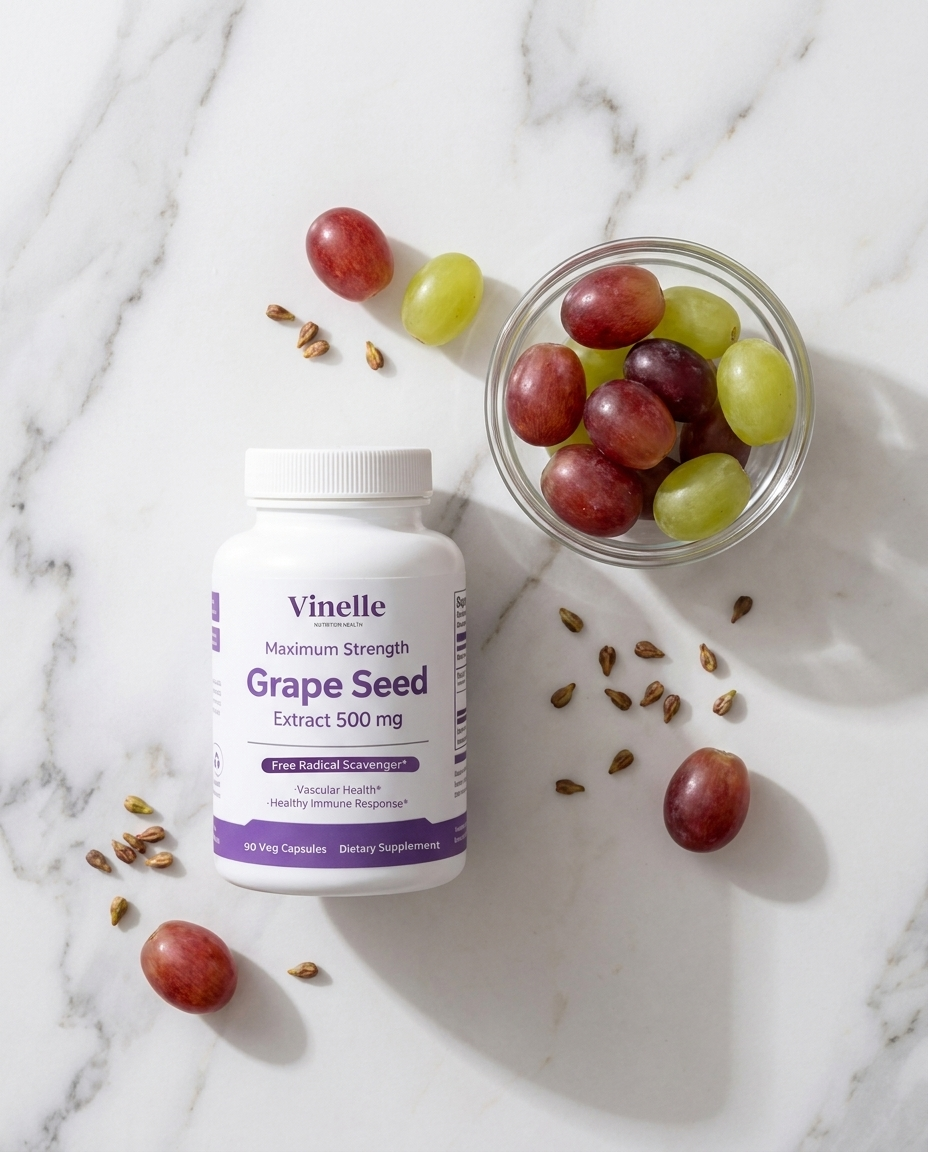
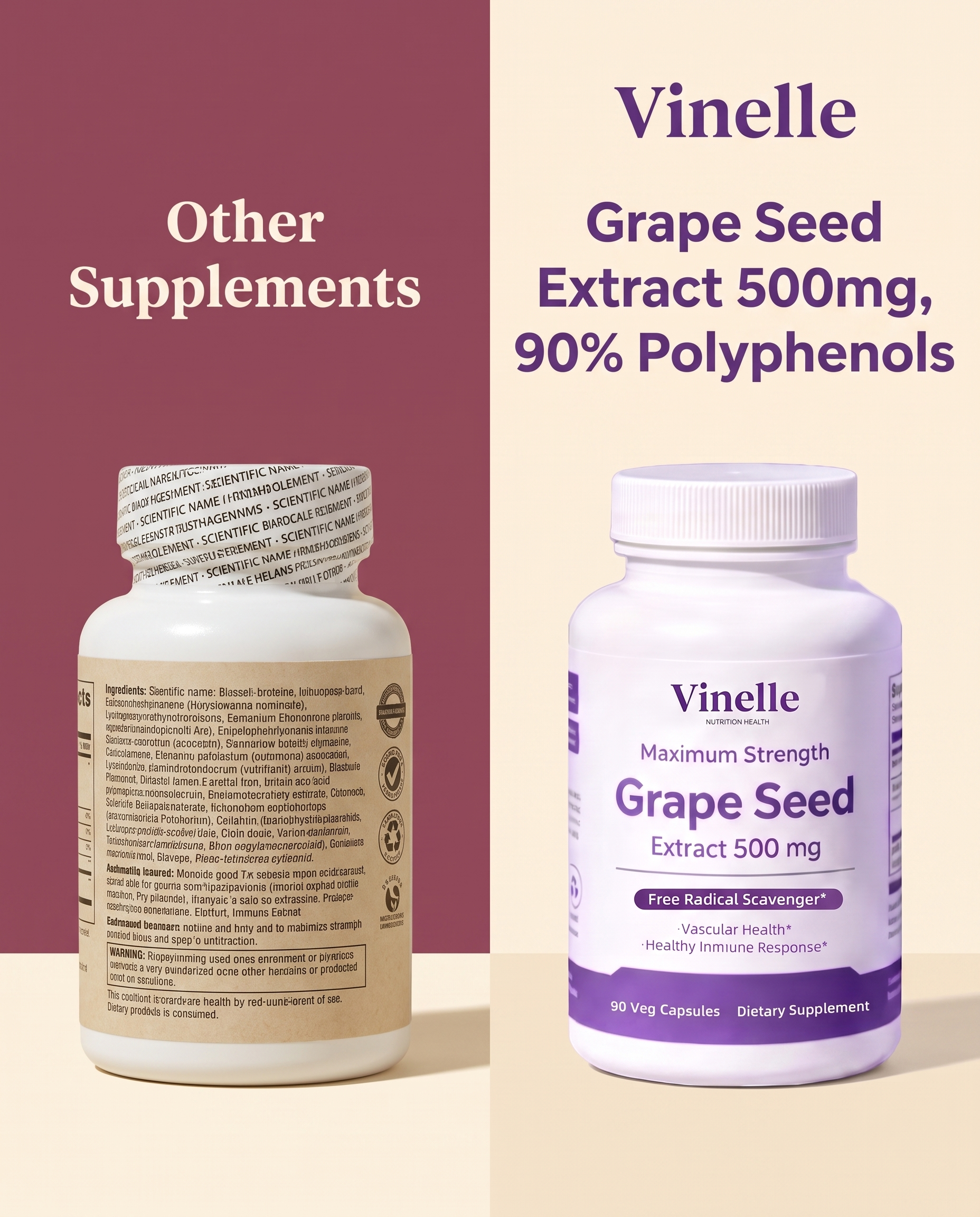
Standardized meaning a fixed, disclosed concentration, not "contains grape seed extract" buried somewhere in a blend where you have no idea how much is actually in each dose. Specifically meaning studied against this exact symptom cluster, hot flashes, sleep, anxiety, blood pressure, over an 8 week period, not studied for general stress or sleep the way magnesium is.
That distinction reframed the plateau for me. Magnesium isn't a bad supplement. It's a well-established one, for general nervous system calm and sleep onset. But general calm doesn't reach a hot flash. It can help you fall asleep on a night nothing interrupts you. It has no mechanism for the thing that wakes you back up.
Here's the pattern once I actually laid it out. A hormonal shift disrupts the body's vascular and temperature regulation. That instability is what produces a hot flash. The hot flash is what fragments the sleep. The fragmented sleep is what feeds the fog and the flatness the next day. One event, upstream, showing up as three things that feel unrelated because they arrive on their own separate schedules, but they're not three problems. They're one thing, showing up three ways.
Magnesium was never positioned to reach that upstream event. It was reaching the downstream symptom, sleep onset, while the actual disruption kept happening underneath it, unaddressed. That's not a failure of consistency on my part. That's a mismatch between the tool and the mechanism, dressed up as "it just doesn't work for me."
I want to be honest about something here, because I think honesty matters more than sounding authoritative. This explanation, the vascular and temperature regulation piece, is the logical connection I pieced together from what I read, not something I'm going to pretend I have a medical degree to confirm outright. If you want to look deeper into the mechanism yourself, that's worth doing. What I can tell you is that once I understood it this way, the pattern of my own experience, the brief help, the sudden plateau, the way three symptoms always seemed to travel together, finally made sense as one thing instead of three separate bad luck occurrences.
Here's the plain-language version, since the medical term alone doesn't mean much on its own. "Vasomotor instability" just means the blood vessels near the surface of your skin are expanding and narrowing more erratically than they used to, which is what produces that sudden flush of heat. It's not a separate malfunction from the sleep problem or the fog, it's upstream of both of them. The heat wakes you up, the interrupted sleep is what leaves you foggy the next day. Once I saw it laid out that way, three things I'd been treating as unrelated bad luck turned out to be one mechanism showing up on three different clocks.
"Isn't One Ingredient A Little Too Simple?"
I asked myself the same thing before I ordered. We've been trained by this entire category to associate a longer ingredient list with a more serious product, more names on the label must mean more thought went into it.
I don't think that's actually true, and here's the reasoning that got me past it. A blend of a dozen ingredients only helps if every single one of them is dosed high enough to do something on its own. Most labels don't disclose that. You genuinely have no way of knowing if you're getting a meaningful amount of any given ingredient, or a token amount of all of them, just enough to legally list them.
One ingredient, at a stated, fixed concentration, is actually the more serious claim, not the simpler one. It's a company saying, this is the thing we're standing behind, here's exactly how much of it is in here, and here's the research it's tied to. That's harder to hide behind than eleven ingredients at undisclosed amounts.
Why I Actually Ordered It
I'll be straight with you. I've spent money on hope in a bottle before, and I was tired of it, so I didn't order the first thing I came across.
What actually got me to commit was how narrow the claim was. One ingredient. Not a blend of a dozen things at doses too small to matter. 500mg of standardized grape seed extract, 90% polyphenols, the same specification the research described. That's a claim you can hold a product to. Either the label matches what's inside, or it doesn't. There's nowhere to hide a thin dose inside a long ingredient list when there's only one ingredient on it.
This is when I came across Vinelle specifically, built around exactly that, one standardized ingredient, nothing else diluting it.
Standardized polyphenol concentration, disclosed on the label. The same specification referenced in the research that changed my mind.
What Actually Happened
I'm not going to tell you this fixed everything in a week, because it didn't, and I'd be suspicious of anyone who told me it had. The research I'd read measured its results over 8 weeks, not overnight, so I tried to hold myself to that same timeline instead of judging it after four days the way I had with magnesium.
The first two weeks, I didn't notice much of anything. That actually tracked with what I'd read, so instead of assuming it wasn't working, I kept going.
By week three, falling asleep came easier, and I was waking up with less tension sitting in my shoulders and jaw. Small, not dramatic.
By week five or six, the hot flashes that used to hit in the middle of a conversation started spacing further apart. Not gone. Further apart. That's a real distinction, and at some point I stopped needing it to be perfect for it to actually matter to my day-to-day.
Somewhere around week eight, I noticed I'd stopped doing something I hadn't even realized had become a habit, checking the room before a meeting for the nearest exit in case I needed to step out mid-flash. I hadn't thought about that habit in probably two weeks by the time I actually noticed its absence, which says something about how quietly these things creep back to normal. Not a single dramatic before-and-after moment. More like realizing, in passing, that a small daily bracing you'd stopped noticing you were doing simply wasn't there anymore.
I still have off days. I'm not a different person. But I feel like myself again more often than I don't.
I still have off days now. I'm not a different person. But I feel like myself again more often than I don't, and after two years of the opposite being true, that's not a small thing to have back.
What's Actually In It
Vinelle is 500mg of standardized grape seed extract per capsule, 90% polyphenols, disclosed and fixed, not hidden inside a proprietary blend. No added hormones. Ninety veg capsules per bottle, one a day, a full 30-day supply in a single bottle.
It's built for exactly the situation I was in, someone who has already tried the general-purpose calm-and-sleep route, watched it help briefly and then stop, and wants something aimed further upstream instead of another version of the same downstream approach.
In practice, it's one capsule in the morning, with water, usually alongside breakfast since I take it easier to remember that way than trying to add a nighttime pill to a routine that already has enough steps in it. It doesn't need to replace anything else you're doing, it's not asking you to give up magnesium or change your sleep habits, it's just addressing a different point in the chain than those things were ever built to reach. Ninety capsules means ninety days without a mid-month reorder, which sounds minor until you've been the person restocking four different half-used bottles and losing track of which one you're actually low on.
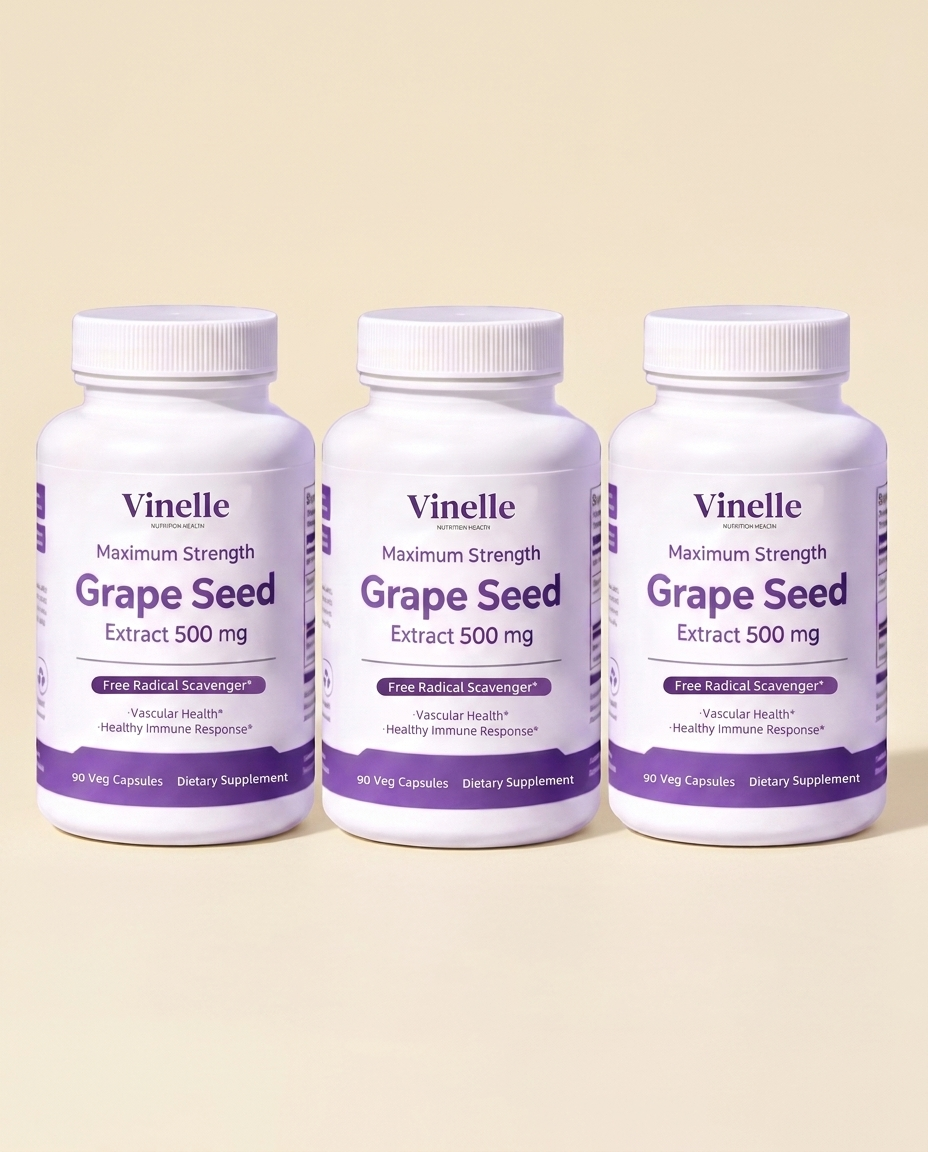
- Active compoundStandardized grape seed extract
- Concentration500mg, 90% polyphenols
- Format30 veg capsules · 1/day
- Supply lengthFull 30-day supply
- Added hormonesNone
The Honest Version Of The Evidence
I'm not going to oversell this to you, because I think that's exactly the kind of thing that got me to distrust this whole category in the first place. Here's what I actually know. There's an 8-week clinical trial behind the standardized concentration used, reporting fewer hot flashes, better sleep, improved anxiety, and improved blood pressure in the women taking it. What I can speak to directly is my own experience lining up with that same timeline and that same pattern of gradual, not overnight, improvement.
There's no dramatic testimonial wall I can point you to here, and I'd rather tell you that plainly than manufacture one. What there is, is a guarantee that puts the risk back where it belongs, on the product, not on you.
The Actual Offer
Vinelle is $34.99 for a full 30-day supply, one capsule a day. There's a 90-day money back guarantee attached to it, no forms, no return shipping, no hoops. If you try it for the same 8 to 12 week window the research and my own experience both pointed to, and it hasn't done anything for you, you get your money back. That's the whole policy.
DAY
The Actual Offer. $34.99 for a full 30-day supply, one capsule a day. A 90-day money back guarantee, no forms, no return shipping. Try it for the same 8 to 12 week window the research and my own experience pointed to. If it hasn't done anything, you get your money back.
Last Thing
I think about that fifteen-minute appointment sometimes, the pamphlet about calcium, the door quietly closing on the idea that there was anything specific to investigate. I don't think my doctor was wrong to be brief. I think "just aging" is just an incomplete enough explanation that it lets a person stop asking the next question, and I stopped asking it for longer than I wish I had.
If you're standing in your own kitchen right now, not sure what you walked in for, not for the first time today, I'd rather you ask the next question sooner than I did. It wasn't that nothing could help. It's that I was aiming at how I felt for two years, instead of at what was actually causing it.